

Tell me, what is it you plan to do
with your one wild and precious life?
from The Summer Day Mary Oliver
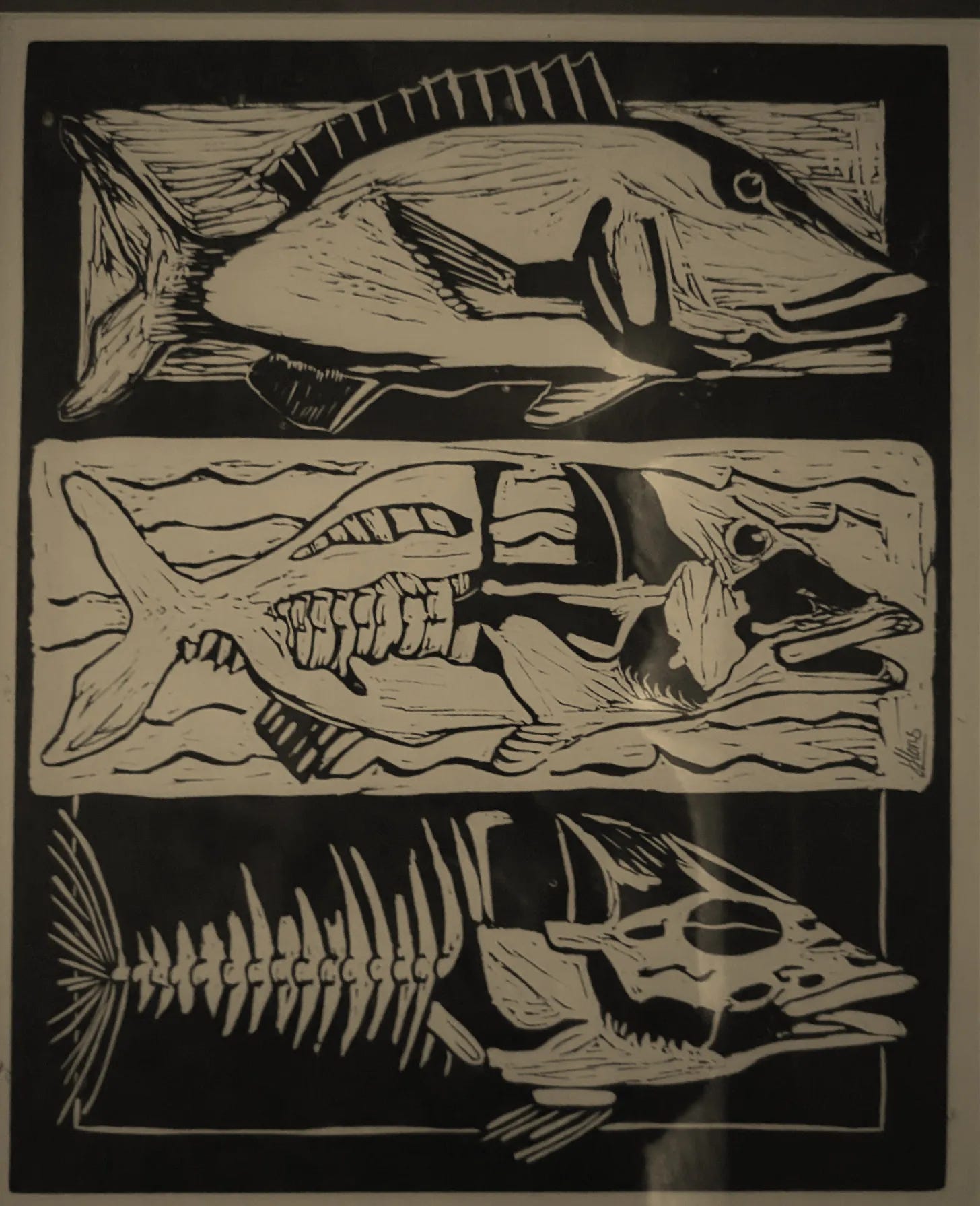
Artwork by my beloved brother, incredible father and deeply missed human Joel Floris
Joel’s absence is a summons. A summons to bring his gentleness; kindness; loyalty; courage; strength; quiet and considered insights; humour; grounding, inspirational presence; and appreciation of life and all that interacted with him into our days. In reality I am not only summoning him but him me, every day from within every cell. Thank you for this summons Joel. I love you.
One of the most surprising and treasured things about this project has been the variation in not only the content that this invitation to respond to the phrase Here We Are brings up and out of each person but also the way the actual invitation has landed for people and then how they approach it. It is so interesting to witness what the invitation cracks open and the opportunity it does ( or doesn’t) release. Recently contributor astrophysicist Tom Murphy contacted me and said “That recording, in spring of 2023, happened at a time of great transition for me as I stretched to shift my worldview pretty significantly. The recording forced me to pull a lot of it together for the first time. So it was a perfect exercise for me, and miraculously remains pretty true to my evolving views”.
Fred Provenza also seems to have welcomed the invitation as a quest to capture it all and his response took me entirely by surprise. I had constructed my own ideas about where I thought this wildlife biologist would go with the phrase based on what I knew of his research and work but I couldn’t have been further from the truth. Fred said to me “I can certainly go in many other directions with those three words but this seems most meaningful to me at this point in time, reflecting back over my years on this planet.” So with Here We Are Fred really went on an epic journey and we are privileged enough to go along with him. He embraced this as a genuine invitation to condense a lifetime of living and learning out of these three words; as an opportunity to deeply reflect on the life he has lived as well as life in general. I really appreciate that he took this as an opportunity to essentially write what could be used as his own eulogy and then was generous enough to share it with all of us. What an honour from an elder. Thank you Fred Provenza and also his friend Jim Boardman who added sound and original music to his recording.
So this leads me to my holiday suggestion and invitation to you ! Find a moment or two or twenty to have a go at writing your own eulogy and/or have a go at responding to or using the phrase Here We Are as scaffolding for this exploration. Lean into this as an opportunity to gain clarity and insight into what you truly value and maybe sow some new seeds or do some weeding and pruning in preparation for growing into 2026 and beyond.
This process of writing your own eulogy may not be as tangible and visceral and quirky as the Japanese offering to reflect on life and death through a ‘coffin cafe’, which is a service provided by a 120 year old funeral home in Japan where visitors can experience entering and lying in a casket. This is an offering described by president of the company Kiyotaka Hirano as a contemplative experience where “coming out of the coffin can symbolise a rebirth, a reset of one’s life. I hope people leave feeling they can begin anew,”.
In lieu of a coffin I invite you write your own eulogy - either for real or as an exercise in gaining insight and clarity into your own life and values.
When you personally write your own eulogy with the intention that it will actually be read at your funeral as a type of “written goodbye, it can be an empowering and beautiful way to say “I love you” one more time. I have never felt more love and healing at one [a funeral] than when a first-person eulogy is read. It’s powerful. Everyone in the room feels they get to have one last conversation with the person they’ve lost.” - Suzanne B. O’Brien former hospice and oncology nurse and CEO of Doulagivers Institute. This may be difficult to write but what a balm for your grieving loved ones and/or potential gift of closure and understanding you are giving by doing this.
Or if you choose to write your own eulogy as an reflective exercise rather than your goodbye letter to your loved ones it could be confronting and challenging in a different way but one that may be potenially empowering and motivational. It may be affirming or it may be disruptive but either way can give you the opportunity to really ask yourself:
Are you making choices that are more aligned to being the person you don’t want to be or the person you do want to be? Are you buying into external pressures or societal expectations and not living your life in the way you truly wish to live it? Attuned Psychology on writing your own eulogy.
An important and potentially useful approach may be to use a third party perspective because “if you were just to write what you wanted in life, you might get caught up in self-criticism or self-doubt” or regret. Set a scene and respond to your own sudden death by writing the eulogy from the perspective of people who know and love you.
This exercise is designed to bring clarity and insight into how you want to be a living your life now which offers opportunities to invest in relationships and actions and legacy work that is meaningful to you before its too late.
I deeply appreciate the courage and commitment with which Fred grasped this opportunity and can only imagine what a gift this recording is not only for us but for his family and friends as well. Here We Are - maps for finding meaning, this is the intent of this project so if you are also feeling brave it would be incredible to expand this project into an opportunity for connection and understanding amongst each other by creating and contributing and sharing our own responses to Here We Are. I’ll do it if you do!
Here. We. Are.
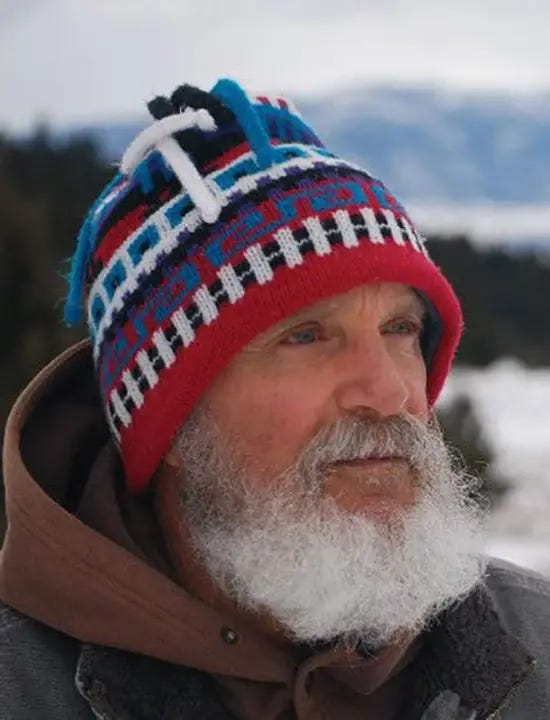
Fred Provenza grew up in Salida, Colorado, working on a ranch while attending school in Wildlife Biology at Colorado State University. He is professor emeritus of Behavioral Ecology in the Department of Wildland Resources at Utah State University where he worked for 35 years, directing an award-winning research group that pioneered an understanding of how learning influences foraging behavior and how behavior links soil, plants, herbivores, and humans. He is the author of:
Nourishment: What Animals Can Teach Us about Rediscovering Our Nutritional Wisdom
Nourishment Article: https://www.ahvma.org/wp-content/uploads/Vol-73-Nourishing-Earth-2.pdf
Interview on Regenerative Agriculture podcast
Endless thanks to the audio, visual and editing legends of Here We Are:
Matt Woodham Treat Lightly
Music by Michael Garfield ‘Listening to plants’


