


I Worship Every Bird That I See
The birds I daily see soaring, flying, singing, perching, hopping, and nesting are inspirations to keep living.
J. Drew Lanham, ornithologist, naturalist, and poet
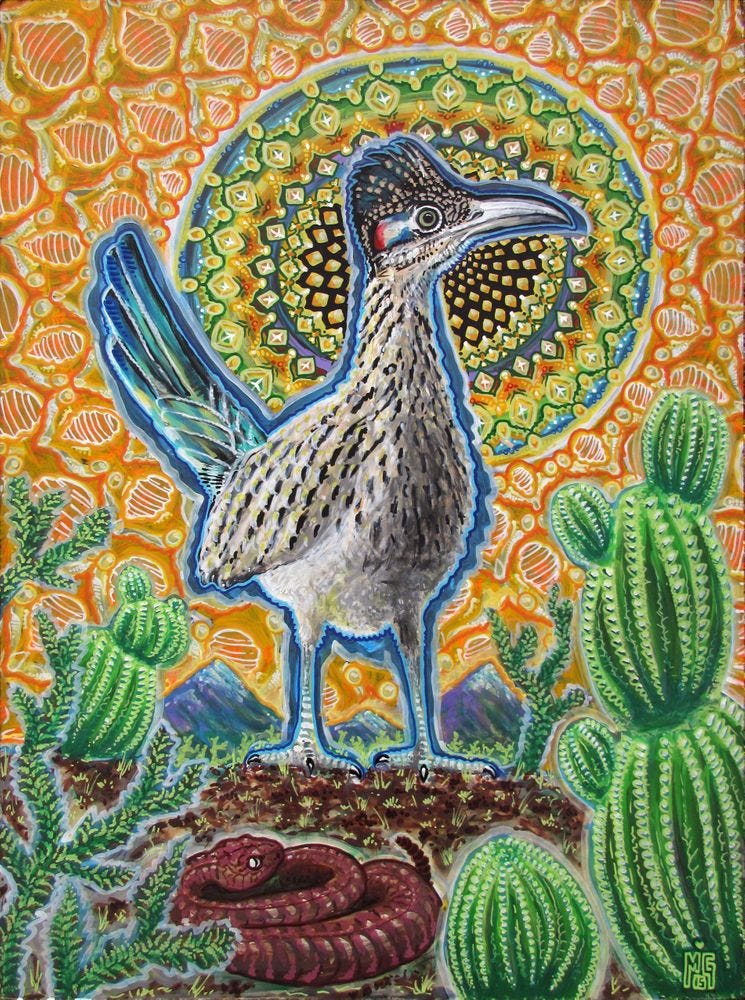
Artwork ‘Road Runner’ by Michael Garfield
Andrew Turbill offers us sooo much gold in this recording but before we dig into that I have to share with you how I even came to be looking for a ‘bird guy’ not just looking but desperately seeking someone to help me decipher bird communication and STAT.
For years I had had a bubbling bird related Speculative Fabulation (a critical, creative method of storytelling used to reimagine, reorder, and challenge dominant, destructive narratives about the world) that I would entertain myself and my children with occassionally. Then my beloved brother died and the bird encounters started moving closer to home and heart and felt ‘meaningful’ and therefore I guess became meaningful.
I had been working in my job as a gardener for 5 or so years so I decided to make a commitment to pay more attention to the birds that spent time in and visited this mixed vegetation hectare size garden on an estate in the middle of a 20 000 hectares farm spanning a section of our the local river system (80+ recorded species). I started letting fantails lead me around the garden, fell in love with the eyes of a black faced cuckoo shrike and accepted the calls from the canopy to be present by silvereyes. This one day in summer I had noticed the movements and sounds of some very small birds, potentially green or European goldfinches that were singing and dancing amidst the cherry plums. I was efforting hard to give them all of my attention (and luckily had a boss who totally valued this use of time and energy) when all of a sudden the atmosphere completely shifted. By atmosphere I don’t mean the layer of gases surrounding a planet, held by gravity, providing air, warmth, and protection for all life though this may have been altered as well. I mean the tone…or mood …or as we say in Australia the ‘vibe’ ala ‘The Castle’ had changed. Suddenly the intangibles shifted, things that were inperceptible or at least not consciously processed by me through the normal sensorial channels were altered. This all happened in less than a split second and before I knew it I was somehow aware and turning around to face a two metre long tiger snake about three metres behind me. This blew me away because I had my back to the snake and I don’t think it made any sound so potentially my awareness of its presence could be attributed purely to a shift in the behaviour of the birds that I didn’t actually notice but still managed to inform me very clearly that there was a threat behind me. After this experience, in an attempt to make sense of it I tried to unpick what had happened and I think rather than a warning call it may have been a deafening silence that warned me of the danger - the birds shut down their movement and sound and essentially disappeared sonically and visually in an instant and somehow my body knew this meant ‘danger’. It reminded me of an experience I had whilst snorkelling in Ningaloo Reef when at lightning speed the diversity of fish and sea creatures I had been blissfully swimming amongst and contemplating moving in with suddenly completely vanished like someone had deleted them from the water and I soon realised why - a shark had entered the space. (spoiler alert I survived but may have shat myself - metaphorically)
So, what was this interspecies communication I had experienced with the birds? Was I special? Things had been getting weird with birds so was I on the path to becoming Dr Doolittle ? or just your normal run of the mill grief induced, dysregulated lymbic system, ND parental burnout style of losing the plot? This precipice between insanity or superpower led to some hard googling which led me to discover Andrew Turbill - the bird guy and his Bird Language course. Turns out I am not necessarily crazy (TBC) or exceptional just ignorant and that prior to becoming a ‘bird noticer’ my brain was suppressing parts of reality that it deemed unimportant but in fact the successful evolution of the human species was attributable to an innate connection and dependence on other species for survival. We homosapiens are as Andrew describes us, a species of bird language samurais.
We are hard wired to listen carefully to birds. To listen and learn. Hard wired in the head literally. Our brains are the top-shelf product of millions of years of neurological tinkering for maximising survival fitness... It remembers and it remains ready to listen again. Because listening to the language of birds, most especially the alarm language of birds, was one of the most critical tools in our ancestral survival-kit. It is simply impossible that even a single one of our ancestors before the invention of agriculture and settled villages wasn’t a master of interpreting bird language. A veritable ‘bird language Samurai”.
For as long as we can imagine homosapiens have ‘noticed’ ie. relied on other creatures behaviour and messages to inform and warn us of environmental changes including the risk of approaching predators. Maybe this is news to you too as it was to me so please take a moment to first acknowledge and shake your head at own obliviousness and then second get very, very excited about the possibility of reclaiming that level of perception and connection with the more the human world.
Thanks to Birds
Birds are dinosaurs who shrugged off a couple of apocalypses.
Some eat bone marrow.
Some drink nectar.
They outswim fish in the sea.
They smile politely at gravity’s demands.
I am grateful to see them. I am grateful to feed them.
I am grateful to know them.
Enter Andrew Turbill. Thank you so much Andrew. Seriously. I needed to access birds quickly. This burgeoning bird focus and story was about to become the reality of an experiment in processing grief through oral storytelling in real time with kids. I was compelled to embark on the story at school that was a calling from my grieving heart and it was coming through birds who I essentially knew nothing about. Unless you were a chicken I had never given any feathered friends any signficant attention because I had been hyperfocused only on organisms that were productive, multipurpose food sources. I quickly googled and started researching like crazy and that is when I came across Andrew Turbill’s Bird Language and Nature Connection course which he very kindly let me participate in immediately - as it was an obvious emergency!! Side note - A friend pointed out that this recent and robust interest in birds may not be a unique experience to me. I could just be following a very predictable chronological path as there would appear to be an inclination for folks in my age bracket to become more interested in the avian world - see following Guardian article “Middle-aged people and birds: it’s a powerful inter-species love story.”
The expansion of the world I came to experience whilst doing the bird language couse was almost psychedelic. I felt genuinely giddy like my sense of reality was unravelling and then as I began to settle into this new world it brought a broader sense of belonging as well as a deeper yearning to participate and understand and make sense of mystifying encounters because excuse the pun, noticing birds meant happenstances and synchronicisties were flying around me. With regards to the storytelling there was a beautiful and almost intoxicating blurring of fiction with non fiction where many of the birds we conjured through the story each week would actually then appear in reality amongst the trees surrounding our story circle in the school grounds in the following weeks. Like we were calling them in and they appreciated being noticed. In addition to the regular avian companions at school like magpies, starlings, sparrows and masked lapwings we found we were vistited by (or more likely just started noticing) ravens, little wattle birds, grey fantails, superb fairy wrens, silvereyes and twice we even had a wedge-tailed eagle encircling us - a wedge tailed frickin’ eagle WTAF. These bewildering yet reaffirming encounters being delivered on the wind provided opportunities to expand our perception and understanding of the world and ourselves. And as Andrew said to me “perhaps it is the strange magic of the inexplicable, or perhaps it is a case of correlation masquerading as causation but birds are our gateway into deeper nature connection. Bird language teaches us how we can genuinely listen to the land” . Our bird unit titled Here We Are getting a birds-eye view introduced students to the biology, ecology, evolution and human historical and mythological relationships with birds whilst sitting amongst the trees. The vehicle was through the story of a grieving child and her bird encounters were not only therapeutic but also offered us a portal for becoming sumbioliterate. This included the development of practical skills and knowledge around bird observation as well as incorporating self regulating practices like the sensory awareness sit spot and nature journalling. These were an intentional integration of life long strategies for reducing anxiety embedded in the broader benefits of nature contact and wildlife encounters …as well as a healthy dose of playful bird mimicry - with the relentless attempts to impersonate correllas in order to trick the bird identifier app potentially increasing the fraying of fragile nervous systems of some of our teachers. For more information on our bird unit see Learning to Fly by Foodweb Education
Birdwatching is the gateway drug to environmental awareness, and teaches us to value birds, which compels us to value their host environment. We stop observing the natural world from “the outside” but step into the landscape as advocates and participants. When we look at a bird, we are actually looking at the sum of numerous ecological processes. One bird can embody the complexity of an entire ecosystem. That’s where the broadening of perception comes in.
Georgia Angus The Guardian Birdwatching changes the way you look at the world
A number of contributors to this project, including Glenn Albrecht, Charlie Massy and David George Haskell identified birds as being the formative organisms for capturing their childhood curiosity and nurturing their appreciation for life which then formed the bases of their path and interest in ecological thinking. This is the type of bird watching Andrew Turbill advocates for - the type that creates naturalists “I want people to ask questions and get lost in enquiry”. In this recording Andrew uses the phrase Here We Are to explore what it actually means and requires to know a place. He reassuringly informs us that becoming a bird noticer can provide remarkably fast access to remembering our interdependence with other organisms as well as a sense of belonging to the life and community of your area.
I think it requires us to be willing to pay attention and to really notice what is really there. To listen deeply, to look carefully, to be patient and to meet a place on its terms. In just in a day or two (of bird language retreat) the brain is re-patterning itself about what you’ve told it is important. Their entire sense of being present and relational with the place just transforms. They (participants) go from being like a tourist in the place to being like a member of the community of a place.
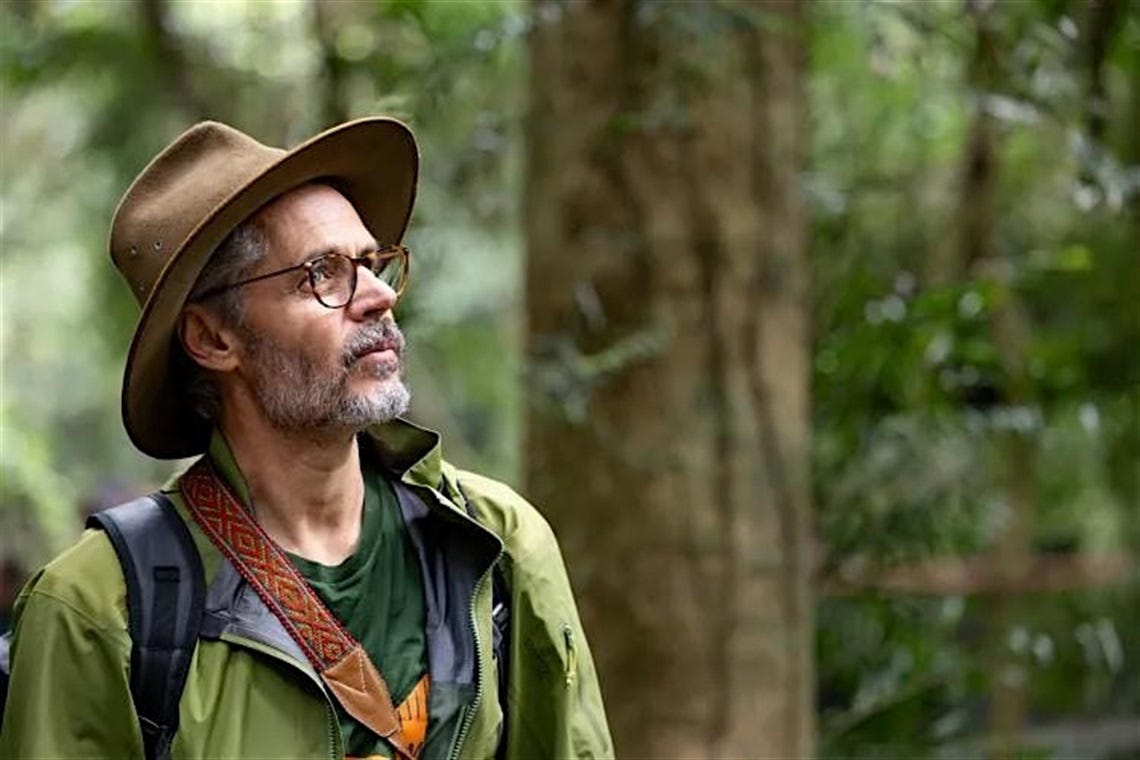
Although Andrew Turbill describes himself as the‘reclusive nerdy type’ he feels compelled to share his accumulated knowledge and insights about how we can connect deeply and profoundly with natural landscapes through paying close attention to birds… he doesn’t mince words as he also believes that without a radical reconfiguration of society’s relationship to nature it should no longer be considered hyperbole to suggest the near-term fate of humanity is utterly rooted! Sooo folks paying attention to birds is urgent and essential. He does admit there can be a challenge getting kids interested in birds when currently there is ‘no real survival consequences or social benefit from knowing stuff about birds’. However, he says the key is to learn the ‘party trick’ of tracking the appearance and movement of predators in the landscape without ever having seen them. Hence although bird alarm is an ideal place to start the bird language journey for most people, for kids it’s pretty much the only way to get a foot in the door. Check out his article How to trick get young people into paying attention to bird language
I can attest that even sharing my experience of the birds revealing the presence of the snake to me through the character in our story and her discovery that this attunement to birds was not only possible but our heritage provided enough shock value, interest and inspiration to be a confident entry point for seeing the world and birds differently. Sharing stories also invites sharing stories and we heard many tales of bird encounters with all students either having or starting to dream of having their own bird story. I recommend you become a ‘bird noticer’ ASAP but prepare for strange and wonderful things to happen and to begin to feel part of something bigger.
Everyone has a bird story. Everyone should have a tree story, an animal story, a night in the woods where the sky opens up and flings your soul in all directions - story. As we must "wait for nature with open palms," we must also venture out with open minds. There is room for all humans to form bird stories.
Thank you Andrew Turbill
Courses:
Bird Language & Nature Connection online
Listen:
ABC radio LNL Summer: Learning the language of birds
Release your inner bat shit crazy bird nerd with Andrew Turbill on Reskililience podcast
Andrew the Bird Guy Blog
Other bird nerds I love:
J. Drew Lanham, ornithologist, naturalist, and poet
Seán Ronayne Irish ornithologist, wildlife sound-recordist, award-winning author, and environmental activist.
Book: Nature Boy: A Journey of Birdsong & Belonging
If anyone can figure out how to watch his documentary Birdsong let me know
Endless thanks to the audio, visual and editing legends of Here We Are:
Matt Woodham Treat Lightly
Music by Michael Garfield ‘Listening to plants’


