


We borrow our atoms. The universe owns them. The universe borrows our love and wonder. Those belong to us.
Economics by Jarod K. Anderson
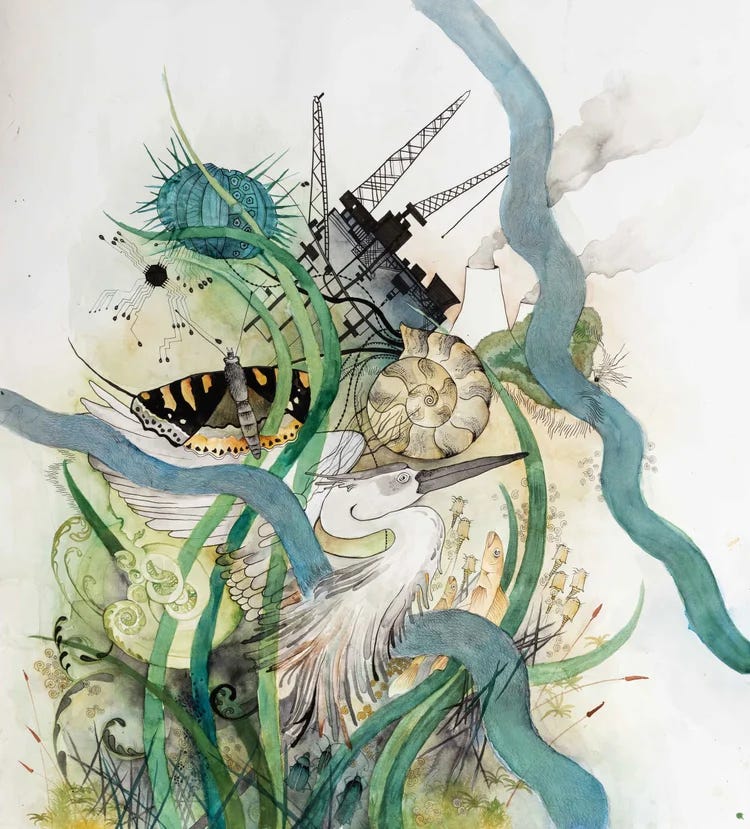
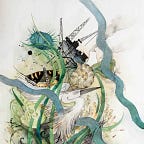
Burning the Carboniferous by Aviva Reed
This artwork “reminds us of the ghosts haunting our world by burning the ancient swamps; hoarding oil, gas and power through greed and violence”. It is available as a FUNDRAISER FOR GAZAN FAMILY please support.
I am not an academic and my neurotype has not blessed me with an ability to retain and access and then convey clearly details and information. I’m starting to gradually accept this now as I approach the age of 50 - an acceptance that instead of being adroit and articulate when encountering ideas and concepts instead they seem to float around and then engulf me like a cloud both around and within my head with seemingly no pathway out of my mouth. Instead they seem to bypass my ‘mind’ and penetrate in through my skin and establish themselves throughout my body. This means I typically feel and sense things (ie. science - I can’t for the life of me recall the details of photosynthesis or the krebs cycle but somehow they form part of the lens through which I perceive the world). I then have very little capacity to verbally express or explain them [though bizaarely I have been driven to a life reframing them for children hmmm (TBC)].
This audio series for Here We Are was not intended to be but has become an opportunity for me to experiment with trying to translate these feelings into expressions other humans might be able to access. My encounters with the work of Karen Barad is an example of this process. I make no claims to be able to reasonably explain their ideas but my visceral response to their words and concepts, a sense of resonance without comprehension in the normal way, was what I experienced. When I reached out to Karen they somehow also sensed the resonance even though I did not have the capacity or language to express it in theirs. I sincerely thank Karen for somehow still recognising me in them. There appeared to be some overlap between my use of matter, objects and phenomenon in my teaching. I admit in lieu of a ‘lesson plan’ I often pull a ‘weed’, seed or fruit -a living prop grabbed from the garden on my way to class - very much like the orange offered by Susan Murphy and the coffee mug Karen refers to. Such objects are infinite in their learning potential and we would embark on various adventures disentangling and focussing on various threads that connect us to them across and through time and space. I would present them as a way to access and create a habit of mind for spacetimemattering which combines space, time, and matter into a single, inseparable whole emerging from their intra-action - or agential realism in Barad’s terms. The prop is a portal to connecting ourselves to the atoms and the dynamic and continuous indeterminant stories of the atoms contained within the living and/or non-living prop like a sow thistle, mug or bottle of water. We discover our ongoing relationships with matter laying the foundations for becoming response-able, able to respond to the complexities contained within matter and our treatment and understanding of it.
The teaching resource I created with the support of the Australian Association of Environmental Education called ‘There is no such place as away’ is a playful introduction to tracing matter across and through all scales and times and importantly through ourselves. We develop a habit for following the stories that different elements take us on as they move in and out of our bodies and gardens. We might adventure with anyone from a fungal spore or a glucose molecule through to the ancient Gondwana forests or the global carbon cycle. We hope using these patterns and habits of tracing will empower our students with a schema for seeing, thinking, and participating in the complex living systems we are entangled with and link us to the stories told by atoms of calcium or electricity powering our televisions. Our human responsibility is then not only to the nature ‘out there’ but becomes about our relationality with every thing. Karen Barad describes this relational ontology as agential realism where entities do not exist as separate, independent individuals before they interact, but rather emerge through their “intra-actions” within phenomena. Science can become and should become a rigorous tracing of entanglements, becoming more accountable to its diffractive role across time and implication in colonialism and ecological destruction. I can find myself getting quite lost very easily in Karen’s work as there is a lot to unpack, new methodologies and many neologisms but it still lands deep in me, settles and feels ….like a remembering.
Diffraction is used for describing both phenomena and as a methodology, illuminating the indefinite nature of boundaries and brings attention to the enactment of those boundaries. A diffractive methodology is a critical practice for making a difference in the world. It is a commitment to understanding which differences matter, how they matter and for whom. (Barad, 2007, p. 90)
At the moment our current unit at school is called ‘Here We Are coming home through food’ and we have been diffracting our ingredients discovering the complexity of uncovering the multitudes of stories contained within our food including the violences and injustices as well as love and social and physical nourishment. From the intentional and unintentional impact and accountability of reviving suppressed and oppressed flavours and the lives contained within the plants indigenous to this land to reconnecting and re-locating ourselves here through replanting them, speaking their indigenous names (the languages this land spoke to First Nations people) and reintroducing them into our palate. We have also been uncovering the literal and figuritive impacts of plants such as ‘sugar’, where the sensory encounter with its sweetness becomes an opportunity to not only acknowledge its addictive qualities and damaging health impacts but also invites us to understand greed and its impacts at all levels, assisting us to acknowledge, digest and integrate an often an unpalatable personal and political, present and past all at once. It can be uncomfortable navigating complex, often contradictory realities but a critical skill or capacity. As Brene Brown said in relation to her own children:
I want my kids to know systems thinking I want my kids to know anticipatory thinking, situational awareness, temporal awareness. I want my kids to have this complex set of skills. I want them to own their mind, own their intellect, own their attention, and own their focus. I want them to read. I want them to understand history. I want them to develop pattern recognition skills because these are the skills of the future.When everything in their brain is saying ‘Pick one, pick one reconcile, I’m uncomfortable. Pick one reconcile, I’m uncomfortable. I want them to be able to hold the tension of nuance and paradox. ’. Brene Brown
In this recording Karen suggests we turn our gardening practices into our cognitive ones as well, digging deeper, questioning our often concretised assumptions, tracing the threads of entanglements like roots and mycelium thoughout the soil. Karen calls for a troubling or reworking of notions of time where we once again hear the call for embracing uncertainty, however, they lean away from uncertainty to indeterminancy. Uncertainty perpetuates our cognitive notions of linear time where there is a passivity in waiting for a future that already exists,that is out in front,that we just don’t know yet, whereas indeterminancy offers a more empowering notion of time as it contains potential and possibility past and present all at once.
The Foodweb Education program including the teaching framework and pedagogy was developed as an explicit attempt to provide our students with the practical, cognitive and social tools and skills to be resilient, adaptive and creative in the face of resource and climate change whilst both challenging and fitting into the limits and constraints of the education system. The Foodweb Education program includes developing ‘superpowers’ like cycle eyes and flux fingers, travelhopping and memory matrix making which I believe are agential realism practices. Although I still can’t confidently explain what Barad’s ethico-onto-epistemology framework is exactly dammit I feel the call for it in my bones and attempt to breathe and sing it everyday.
With immense unknowable threads of gratitude I thank you Karen.
Also FYI or those like me that were like WTF ?? - Nature on Trial: The Case of the Rooster that Laid an Egg | SpringerLink https://share.google/UXXNu0ufAe0VKW9qy
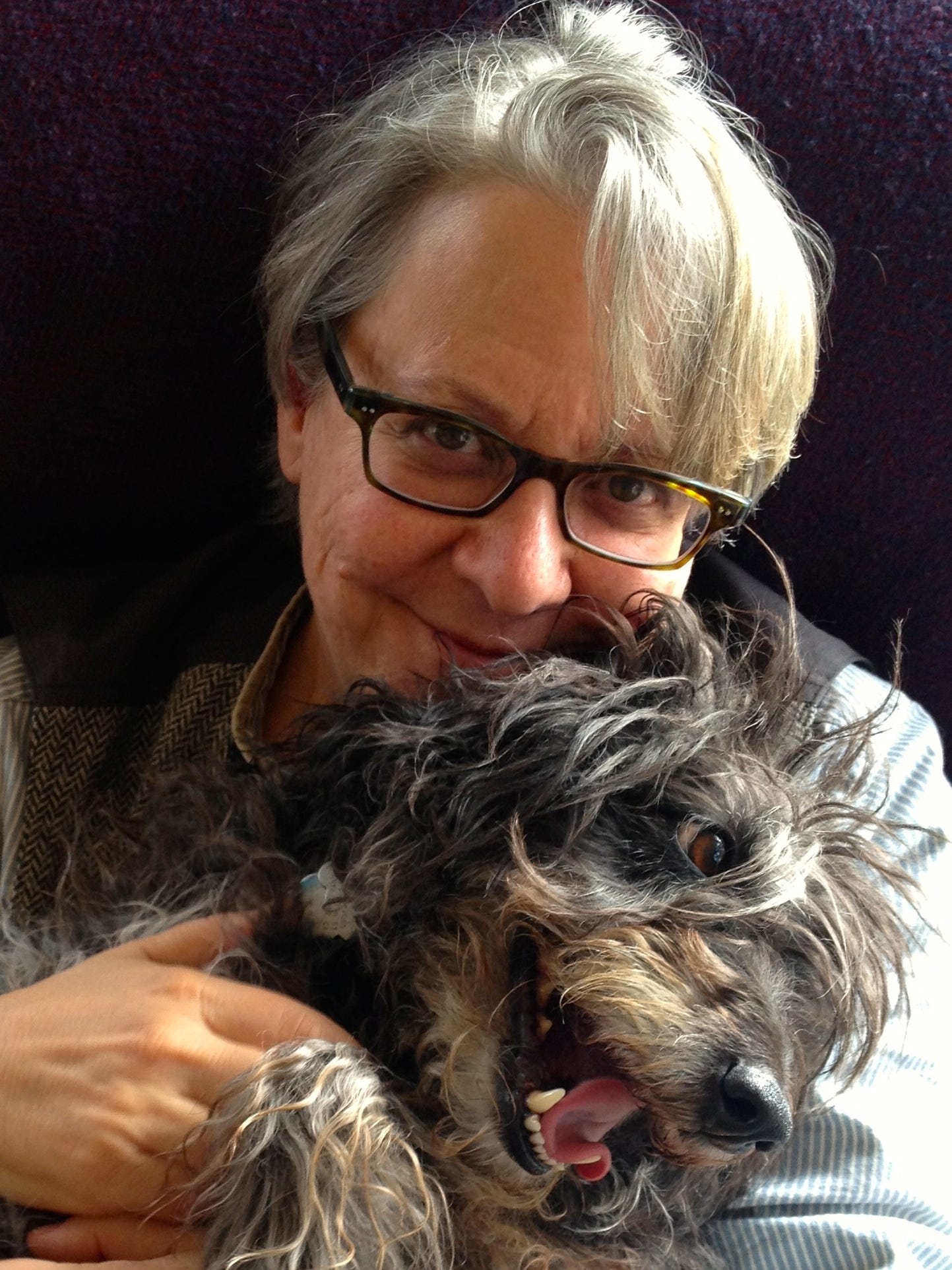
Karen Barad is Distinguished Professor of Feminist Studies, Philosophy, and History of Consciousness at the University of California at Santa Cruz. Barad’s Ph.D. is in theoretical particle physics and quantum field theory.
Karen is the author of Meeting the Universe Halfway: Quantum Physics and the Entanglement of Matter and Meaning
Here are some video lectures available online -
Karen Barad: Nuclear Hauntings & Memory Fields, For the Time-Being
Karen Barad: After the End of the World..
Karen Barad. Troubling Time/s and Ecologies of Nothingness
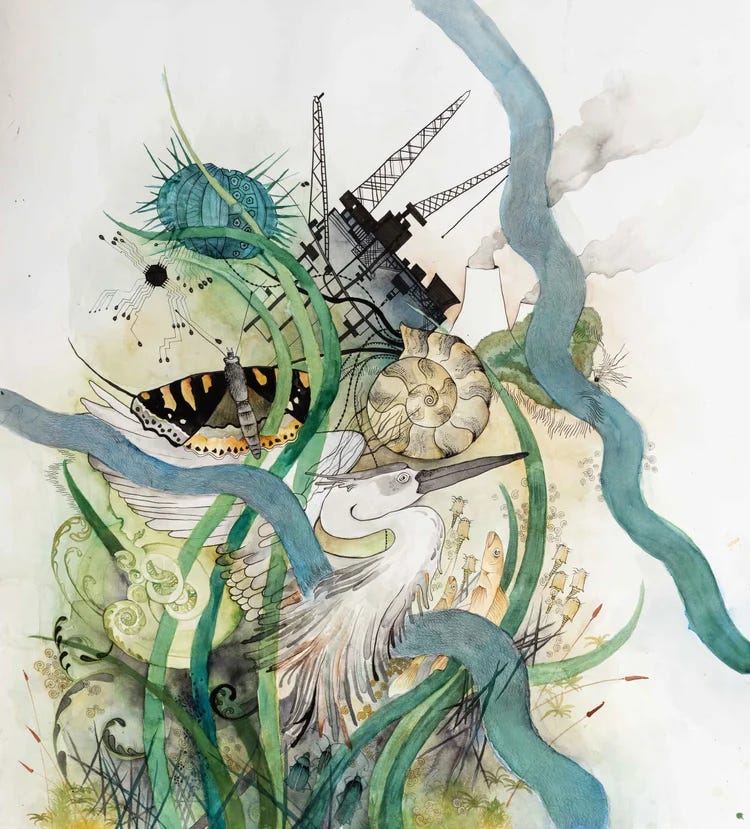
Artist Aviva Reed has offered her artwork ‘Burning the Carboniferous’ for this post and has produced a fundraiser where all profits from the sales of prints of this piece goes to a family in Gaza.
Aviva says “I have been raising funds for Ibtisam and her family, who are living in flooded tents in a cold winter, for a few months now, but life gets harder and harder in a genocide.
This work, ‘Burning the Carboniferous’ reminds us of the ghosts haunting our world by burning the ancient swamps; hoarding oil, gas and power through greed and violence..
The eternal light that guides us should be love,
not greedy oil demons, not racist power trippers.
We are betraying the future of humanity,
the future of the planet”.
Link for print sales or donations http://www.avivareed.com/shopav.../burning-the-carboniferous
Thank you Aviva.
Endless thanks to the audio, visual and editing legends of Here We Are:
Matt Woodham Treat Lightly
Music by Michael Garfield ‘Listening to plants’


