



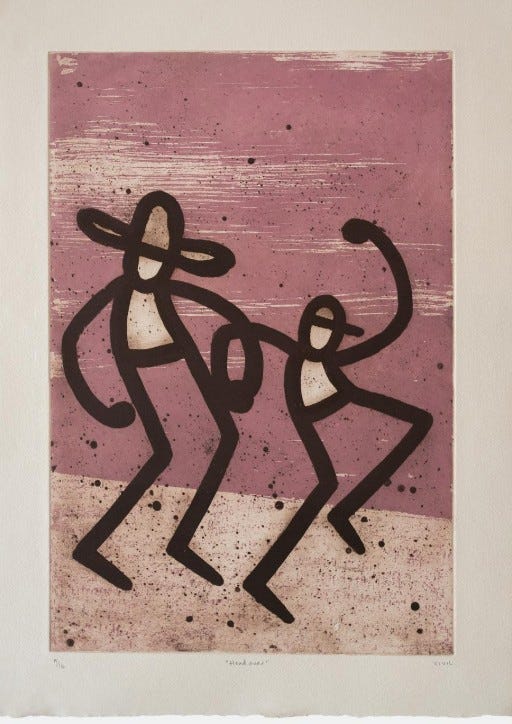
HAND OVER by Tom Civil This artwork for me is about generational change – older people passing knowledge down, and younger people stepping up to the challenge, as well as passing knowledge up – all while holding each other through the process and caring for each other.
AVAILABLE TO BUY ONLINE at PG Gallery, Fitzroy, Melbourne @printmakergallery
Our Education System Is Failing Because It Is Doing Exactly What It Was Designed to Do!
Our best efforts at modernizing education have failed to improve the lives of students or change society for the better. This is no accident: the current system is failing us because it ignores our deepest knowledge about how human beings thrive. Being “smart” today is still about sorting kids based on how well they absorb and retain knowledge. We need education to reflect a different set of values: interdependence, community, diversity, and deep, dynamic learning. We need it to align with human development, facilitate learning for different kinds of brains, and prepare young people for a changing society and evolving workplace.
Ulcca Joshi Hansen
Over the last few years I have found myself being both clarified and fortified repeatedly by Ulcca’s thinking and words. Some back up my feelings with academic research and others map out and articulate my professional and personal direction and sense of purpose. In fact they may have become so integrated into my thinking that I probably should have a footnote at the bottom of everything I say referencing her - so apologies Ulcca if you hear yourself in me without quotation marks. Consider yourself deeply acknowledged.
Similar to Ulcca, I like to include an opportunity in any professional development I facilitate or program offering with time to contemplate and then come from whatever is generated by the question ‘What is education for?’ and then of course ‘what is my role?’. As both educator and/parent/carer it so important to keep asking ourselves this and this iterative inquiry aimed at everything that impacts a young person’s ecosystem from our personal motivation through to systemic objectives runs throughout Ulcca’s work.
Ulcca’s post-covid call was to look our children in the eyes and really think about what we want for them. I heard this call like a memory revived and it continues to call into the depths of my heart to ground ourselves in that feeling, to remind ourselves why it’s so important for a young person. So, I sometimes like to think about when was that moment? When somebody an adult, a supervisor, a mentor, a family member, a teacher saw me. Really created this moment for me, that sort of allowed me to just see myself as something more …and to kind of hold on to that. As this being the thing that we want to kind of create more than anything for young people in the moment, a moment, especially for educators, right?
Yes! this is the business I want to be involved in. This is what Here We Are is all about and Ulccas offering to the Here We Are has captured so succinctly and powerfully much of what brought me to use and want to share this phrase.
Whether you are a parent, carer and/or educator being with our children and young people we are intentionally working with human potential. Every moment we are with children, we play an active role in their unfolding. As parents, carers or educators we are committed to little people which means we are committed to our relationships with them. The thing we may often forget or dismiss is that they also play an important role in our unfolding. Here We Are can be a useful reminder of that. So what we bring to our parenting and educating is a pretty big deal and a responsibility that I take very seriously.
As I mentioned, I have found great clarity and comfort around identifying and understanding my roles and relationships with children through Ulcca Joshi Hansen. Operating most of the time in a silo she has helped me to recognise where and how and why I do what I do. For the longest time, I have been driven by the desire and need to ‘create spaces and opportunities for young people to not only discover, evolve and nurture who they are in the world but where this intersects with what is needed in the world’. It has been key for me to discover through Ulcca’s capacity to articulate so many aspects of education that this is the space where I have been working. Bringing Here We Are into this understanding has also ensured I invite myself into this purpose and these processes. Yes I am trying to enable and empower children to embrace their passions and interests within a lived experience of how that fits into what is needed in the world but I am also fulfilling that for myself. It is my own attempt to express who I am and perform what I believe is needed in the world - so Here We Are allows me to acknowledge as well as sort of dance in this space with my students or children.
Now, the other part of this for me is the call to discover where potential and passion intersect with what is needed in the world. For me this has been the critical component of my work as I try to create experiences and habits of mind that match patterns and processes of how the world works and not just the structures temporarily upheld by fossil fuels. So my work has focused on reconnecting us with these realities of how life and the world works not just this socio economic blip. As I have mentioned previously, one of my proudest moments was when a year 4 student described to a new student that ‘gardening class is where we learn how the world works’.
So, Here We Are also provides the guidance for this exploration. How is it that we come to be here, alive, at this moment, in this place, together. In order to understand what is needed in the world I feel that you need to have a lived experience and understanding of how the world works. Not just learning about it formally but witnessing and participating in how the earth operates, how life emerged, and evolves and continues on and seeing where and how you fit into and participate in that. We belong to the earth, we are earthlings.
This is why I find gardening with children such a powerfully simple way of rediscovering our intra-action, our interconnectivity with the world. A garden puts you actively and intentionally IN the living world. The reality is every involuntary breath we take, every mouthful of food we eat and glass of water we drink - essential activities to sustain life - we are participating in the world but unfortunately these actions are not embedded in us as connective practices. Through gardening though, you are actively, consciously participating in an integrated, complex, interdependent world, and you get to witness and to know a living system whose processes, relationships, regulating properties, patterns of organization are the same as the wider systems and world we live in.
As I have said previously, gardens provide a simple and potent way to enter the complexity of life and find yourself participating in it ..but a garden is not necessary to do this and not everyone has the privilege of accessing one. Bringing awareness and enchantment to mundane activities like breathing and storying and tracing matter and energy from glucose molecules to ourselves to the amazon rainforest or through the global carbon cycle you are building in a sense of belonging both locally and to Earth as well as connection across time and space and this can take place anywhere at anytime whether you’re in a garden or not. Forming these habits of mind is how I see us coming to begin to re-belong to Country which is is an Aboriginal English word that contains both the visible and invisible world around us; people, plants, animals, landforms, weather systems, the animate spirit that infuses us all, the stories and the web of relationships between us. We are Earthlings - inhabitants of this planet. “You’re an earthling with other earthlings, and our job is to figure out how to live and die well, with other earthlings”. Donnay Harraway, Tools for Multispecies Futures. So this for me is a critical component of human centred libertory education Ulcca speaks of which requires changing not just structures of education but our entire understanding of the endeavours purpose and who young people ARE in relationship to the work of learning” (The Future of Smart, p. 87)
Ulcca’s work traverses and holds with great clarity all aspects of the ecosystem of young people from human development and relationships to guidance around the bigger picture of education.
Her book ‘The Future of Smart” is for anyone concerned about the future of education. She explains the disconnect between what we want for our children, and what education today provides. She shows how we can build an education system to nurture the unique, human capabilities of each child, and lay the groundwork for a more equitable, just and humane future.
This refers not just to cool add ons, and not even to structural change but to actually “rethink the basic assumptions that have driven education for centuries - assumptions that structure much of society as well” (The Future of Smart, p. 87). Ulcca has provided clarity for me around my role and engagement personally and in relationship with my students but also where my work fits into the historical and broader context of the education system and a means for identifying and understanding where the leverage points are. She has helped me understand and to some extent accept and own why my work (and my life) has felt so incongruous with the mainstream.
For over twenty years I have operated an unconventional program in conventional schools predominantly in low socio-economic areas in the public sector. Although this has been frustrating at times or put more crudely often feels like ‘pushing shit up hill’ or ‘bedazzling a turd’. I have repeatedly felt quashed by a sense of insignificance, questioned the value of and been generally confused by the vast quantities of energy (mental and fossil fuel) it takes to perpetuate this monolith - the industrial factory model of education.
And I think it’s really important to understand that divide in world views and the ways in which the factory model really reflects this Cartesian Newtonian ethic. And when we point at the factory model, we’re not pointing at how things are organized. Or at least that’s not what I think we should be pointing at. I think we should pointing at a different way of being in the world and creating systems that then allow us as human beings to be in the world in a different way.
The question is then is the purpose of education to create economic and social units, or is the purpose of education to help create thriving human beings who have what they need to live purposeful lives
Transforming the Factory-Model of Learning
The industrial factory model of education is not designed around what we know about how human development happens, how learning happens, what human beings needs to thrive but there’s a second way of understanding the world that is a more holistic indigenous way of understanding the world that births an education system whose purpose is to say every young person has potential and the purpose of education is to help them unfold and find and develop that potential. And so what I would love to see is more people thinking about what it takes to design a system that intentionally supports programs and models and experiences that are supporting that purpose of school.
Rethinking School: Dr. Ulcca Joshi Hansen on Equity, Technology, and the Future of Learning
I struggle everyday with this conflict and it is heartaching and heartbreaking to witness and hear my son describe the erosion of his vitality through schooling. This is why I do what I do where I do it because our family does not have the option to homeschool or attend a private independent, human centred libertory school. We are making do with what we have access to within our means and if my son’s soul is crying for more and desperately needs something different then I know he is not alone. Before having children I believed every school needed this program to bring about the necessary but gradual systemic change to repair and revitalise all living systems from individuals to communities to global. I am less ambitious about this now but still believe in it whole heartedly. And now its intense in a more personal way as I am confronted daily with there being nothing about being on the treadmill of modern life including the education system that makes my son ‘feel like a real person‘ which is how he felt having his little feet submerged in a river in the rainforest. And it is not for lack of caring, attentive and inspired teachers there’s something else going on as result of being timetabled and boxed. As a parent bound to this system this is devastating and I ask myself everyday what kind of education would make him and all young people feel like ‘real’ people? To belong to and be part of and be meaningfully contributing members of communities - human and more than human. I may not get to be his teacher (yet) but I am somebody’s teacher and I aim to create the space and time for them to even just for a moment touch this reality and be seen.
Thank you Ulcca for the tools and maps for understanding and navigating this space and providing pathways forward. Here We Are.
We are living in a moment of profound disorientation. The systems we built to make sense of the world — our schools, our institutions, our ideas about intelligence and human potential — are straining under the weight of change. And the stories we told ourselves to build those systems matter. We ended up constructing a reality that reflects them. Which means if we want to change the reality, we have to change the stories.
Here We Are is an invitation to do exactly that.
The answer, I believe, lives in here, we, are.
Presence. Relationality. Being.
These are not soft skills. They are the substrate of everything else. And ironically, it may be the rise of artificial intelligence that finally gives us permission to remember this. Not as consolation. As invitation.
Here we are. In this moment of uncertainty and possibility. In this body. With each other.
That is not the consolation prize of being human. That is the whole point.
Educating Potential Empowering people with new tools and frameworks to engage in the work of transforming education. Building The Future of Education
Book: The Future of Smart®
Listen: The Future of Smart podcast
Watch TED X Rethinking the 3Rs: The Future of “Smart” | Ulcca Joshi Hansen
Endless thanks to the audio, visual and editing legends of Here We Are:
Matt Woodham Treat Lightly
Music by Michael Garfield ‘Listening to plants


