


When I am among the trees
by Mary Oliver
When I am among the trees,
especially the willows and the honey locust,
equally the beech, the oaks and the pines,
they give off such hints of gladness.
I would almost say that they save me, and daily.I am so distant from the hope of myself,
in which I have goodness, and discernment,
and never hurry through the world
but walk slowly, and bow often.Around me the trees stir in their leaves
and call out, “Stay awhile.”
The light flows from their branches.And they call again, “It’s simple,” they say,
“and you too have come
into the world to do this, to go easy, to be filled
with light, and to shine.”
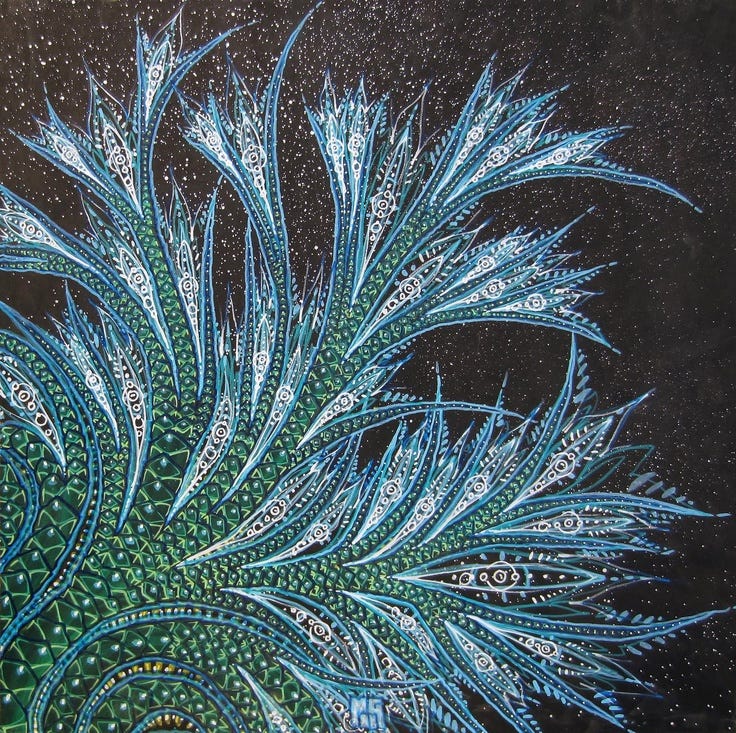
Tree of Eyes by Michael Garfield
The simple act of breathing is an affirmation of our relations with plants.
Because every time you take a breath, you, in a very real sense,
are breathing in the offering of plant folks.
In a wondrous cycle of gift-giving, plants provide the oxygen we need to live.
We, in turn, offer carbon dioxide back with our breaths, which the plants absorb and take into
their own leafy bodies.
I give my air to the trees so they can breathe thank you trees and thank you me
They give their air back to me so I can breathe thank you trees and thank you me
This is a little rhyme I have sung with children as a way of acknowledging our reciprocal relationship with plants and building in a practice of gratitude for the more than human; the beings and processes which remains hidden from our consciousness and taken for granted. You can sing it as you walk around the garden greeting the trees or to your house plant or moss garden over breakfast or as a lullaby before sleep. When I heard Gavin’s we breathing exercise it felt like the grown up version so I am very grateful that he shared it with us for the Here We Are project.
The cute little ditty I sing with the kids does offer real value for building a habit of gratitude and connection, however, I do want to acknowledge that photosynthesis is not as simple an equation as one for one exchange. In reality photosynthesis is a super complex process that we still only understand the basic principles of. We know it occurs in two main stages; one in which plants consume carbon dioxide during daylight hours (light dependent reactions) and the other where they produce CO2 at night through respiration (Calvin Cycle - light independent reactions), however, the amount of CO2 absorbed during the day through photosynthesis exceeds what is released at night ensuring that plants remain a net carbon sink, meaning they absorb more than they emit, however, with climate change research is indicating that the amounts of CO2 emitted may be increasing.
So there’s that but also as with everything, photosynthesis still carries so many microscopic mysteries and remains way more complex, indeterminant and elusive than we can imagine. For eg. scientists are only just beginning to get interdisciplinary and combine physics and biology in an attempt to understand the role of a single photon in photosynthesis as a means of studying the quantum properties of living systems to truly understand them.
However, even without all the tiny, fine-grained, entangled details the basic reality is we remain completely dependent on plants for oxygen (amongst many other things) so it is valuable to engage in simple, even simplified practices of bringing an awareness to the exchange and our relational interterdepence with plants. We, and all heterotrophs rely on photosynthetic organisms for their oxygen production not to mention the initial transformation of the atmosphere that provided the conditions for the evolution of multicellular life as well as the conditions for its continuation. Thanks photosynthesizers!!
One of the simplest ways to be present to this relationship, to this reciprocity, to the kinship we share with our fellow earthlings and with the earth itself, is our breath. We are literally inspirited by plant exhalations.
Bringing attention to the relational aspect of our co-existance with plants also highlights other aspects of our dependence on plants and starts producing and populating glossy catalogues of their gifts - well in my mind anyway.
This week the front cover of my catalogue is showcasing the oft-maligned plants of our lives who at times of crisis and the threat of scarcity might find a renewed appreciation and reclaiming of respect from the human species. As the value of every dollar increases so too might the nutritious potential of many plants classified or at least perceived as a problem - weeds!
This is not intended to be a controversial post I just want to draw attention to plants and our strange attitude and lack of nuanced perspective towards certain ones…and perhaps subtly recommend dusting off or investing in your copy of legends Annie Raser-Rowland and Adam Grubb’s books The Weed Forager’s Handbook or for the kiddoes Let’s Eat Weeds. Introducing yourself and becoming familiar with ‘volunteer’ plants and recognising the value of plants that survive and thrive independantly of us, often in inconcievably challenging conditions and as a natural rehabilitation response to the decimation of the environment is probably pretty timely on a practical and philosophical level. And also let’s just do a collective cheer for volunteers in general, often doing the dull, the difficult and/or unappreciated but totally essential tasks to set up the conditions and ensure others can have a go or years into the future create something beautiful in life as a result of their effort, care and concern. Thank you volunteers!!
I will never forget the overwhelming sense of relief then gratitude that I had for Fathen Chenopodium album when I returned to a school garden after a brutal summer over a decade ago to discover baked pumpkins on the footpaths and scorched plants everywhere with nothing to harvest…. except for fathen. What a godly sight - verdant and unphased and ready to share the abundance of nutrients with iron levels often exceeding cultivated spinach, as well as filled with protein, vitamins A and C, calcium, potassium, and essential amino acids like lysine. Over the coming weeks we set about making dishes like palak paneer, spanikopita and spinach dips with her nutritious leaves and had parents asking where they could get there hands on this much loved new school garden ingredient - I suggested the railway lines. The genus Chenopodium supplies tasty and nutritious leaves and has the ability to grow under stressed conditions like low rainfall, high altitude, thin cold air, hot sun, and sub-freezing temperatures, is tolerant to cold, drought and salinity making it a valuable and versatile food source like so many of our ‘weeds’ (Chenopodium album Linn: review of nutritive value and biological properties) Hilariously, I have been trying to ‘accidentally’ cultivate fathen at home and preciously guard the one plant that has popped up near our compost bin. And also while we’re tweaking our glasses of perception - can we just take a minute to check the price of dandelion root or leaf tea (its approx $100kg pre collapse prices) yet we weed those m#$tha f$%kers out like crazy. And I haven’t even mentioned the insect or animal and bird fodder, habitat creation, soil stabiliser, indicator, fertility and structural building potential of many ‘weeds’. As I said not intended to be a controversial post just often perplexed by my fellow humans.
This week I have been harvesting that much despised but ironically very popular fruit - blackberries. Where typically this late summer foraging activity may be an optional, fun family weekend experience this season I feel the element of and perhaps increasing necessity of harvesting from such volunteer crops - those produced not only without our input, inputs or concern but often whilst we cast contempt on them.
I do not claim to completely understand or intend to be flippant about the impact of many invasive species especially blackberry which I have never had to contend with on a large scale and realise is what has been categorised as a weed of national significance but I do think it is important to keep checking ourselves and stretching the lens through which we may view certain plants and the way we use or don’t use them especially as the systems we know and expect and depend on unravel and collapse.
These gentle and expansive connective exercises provided by Gavin offer an embodied re-entrance into relationality with plants but we may find ourselves being involuntarily thrust more urgently into them. We may be forced to bring plants back into our consciousness, acknowledge and turn our attention back to them as our dependence on them for nourishment out of necessity becomes unavoidable. An edge of wild lettuce might become more attractive when painkillers are hard to get. Nettles might encouraged instead of cursed when beef is no longer an option. Blackberry may have an appeal when there is no fuel to cook food. Who knows …
So at this time I find myself asking what do you do when you can’t afford or access the hydroponically produced (but still somehow ‘organic’) berries on the supermarket shelves or freezers often imported from overseas anymore? (especially when one of your neurodivergent borderline ARFID child’s limited range of safe foods includes berries ahhh). Well you role up your sleeves and get foraging (though with blackberries I recommend rolling down you sleeves - and not wearing your precious, vintage kimono gifted to you by one of your best friends). Admittedly, we usually forage for blackberries anyway in our family at this time of year and luckily for us the added touch of desperation has never really been more than an intellectual experiment and not the now long anticipated reality it is becoming. I could be wrong but if sweet, energy rich, sugary, vitamin filled, microbe innoculating, joy giving, apocalypse surviving berries are the only thing you might be able to access to accompany your damper I think the gratitude for them might reach religion creating levels. I definitely said a few hallelujahs when I had a punnet of freshly picked blackberries to offer my hangry dysregulated AuDHD child after school.
How might we step carefully into an appreciation for the invasive, seemingly unstoppable and officially labelled ‘noxious’ weeds that let’s face it were imported through colonisation and we now are forced to co-exist with? I’ll never not be baffled by humans insistence on applying the same shortsightedness that brought them here in attempts to extricate or manage them. If nothing else weeds really do offer fertile grounds for self reflection and critiquing everything - if you’re that way inclined! They offer us a constant invitation to question our assumptions and investigate the stories contained within the intricacies and intimacies of our relationships with plants and theirs with world and the worlding of the world. Reflect on this explanation of invasive weeds - that they are often introduced species who outcompete native plants for resources, reducing biodiversity and disrupting natural ecosystems. Ah-hem. It’s a bit confronting isn’t it. So harvesting is a practical way of engaging in our shared responsibility and coming to interact with these plants in an intimate, relational way that opens us to observation and potentially understanding them in a more nuanced way. Edible ‘weeds’ such as blackberry and fathen which have travelled alongside humans for millennia are also often densely nutritious and medicinal as are many of those that follow our footsteps around the globe being important survival companions not to mention the forebears of our popular agricultural crops.
As annoying as harvesting blackberries can be there is a part of me that appreciates that they demand we take time, consider our approach, put in genuine effort and typically incur some physical suffering and/or injury in exchange for the fruits of their labour. They remind us that pain and love, joy and suffering go hand in hand. They have a built in equalizer. You really have to work for them and you really appreciate them once you have them and they don’t ripen all at once so there is no incentive to strip them bare even if you had the stamina and arms of steel to do that. I like that the blackberries have their own mechanisms for ensuring we apply the honourable harvest to them …whether we are proponents or adherents to it or not. Jokes aside though, as we reach out to our plant kin closer to home more and more as a means to supply and supplement our nutrient, sensory and spiritual needs it is important to approach them with the guidelines of the Honourable Harvest. So please carry them forward with you even when times get desperate.
Ask permission of the ones whose lives you seek. Abide by the answer.
Never take the first. Never take the last.
Harvest in a way that minimizes harm.
Take only what you need and leave some for others.
Use everything that you take.
Take only that which is given to you.
Share it, as the Earth has shared with you.
Be grateful.
Reciprocate the gift.
Sustain the ones who sustain you, and the Earth will last forever.
With a mixture of blackberry juice and blood on my hands from their thorns I was reminded of our history, and invited into our present and the need to remain strong, stand our ground to protect and defend what is right whilst nourishing and nurturing and bringing sweetness and joy into the lives of others who we may never know or see benefit from it. Remember the blackberry and also bring juicy joy and love to the resistance and fight. Like all plants go easy, be filled
with light, and shine.
I hope you are blessed with the heart like a wildflower
Strong enough to rise again after being trampled upon,
Tough enough to weather the worst of the summer storms,
And able to grow and flourish even in the most broken places.
Hearts Like Wildflowers, Hearts Like Yours | Nikita Gill
Thank you Gavin for this guided invitation into our daily divine reciprocity with plants by providing a practice to get out of our own heads and imaginatively join in the collectiveness of the landscape as a way for us as relational and deeply related beings to feel our connection with the world and of course thank you to all the plants out there quietly keeping us alive. Sorry there’s a bunch of pedophilic megalomaniac fascists at the helm.
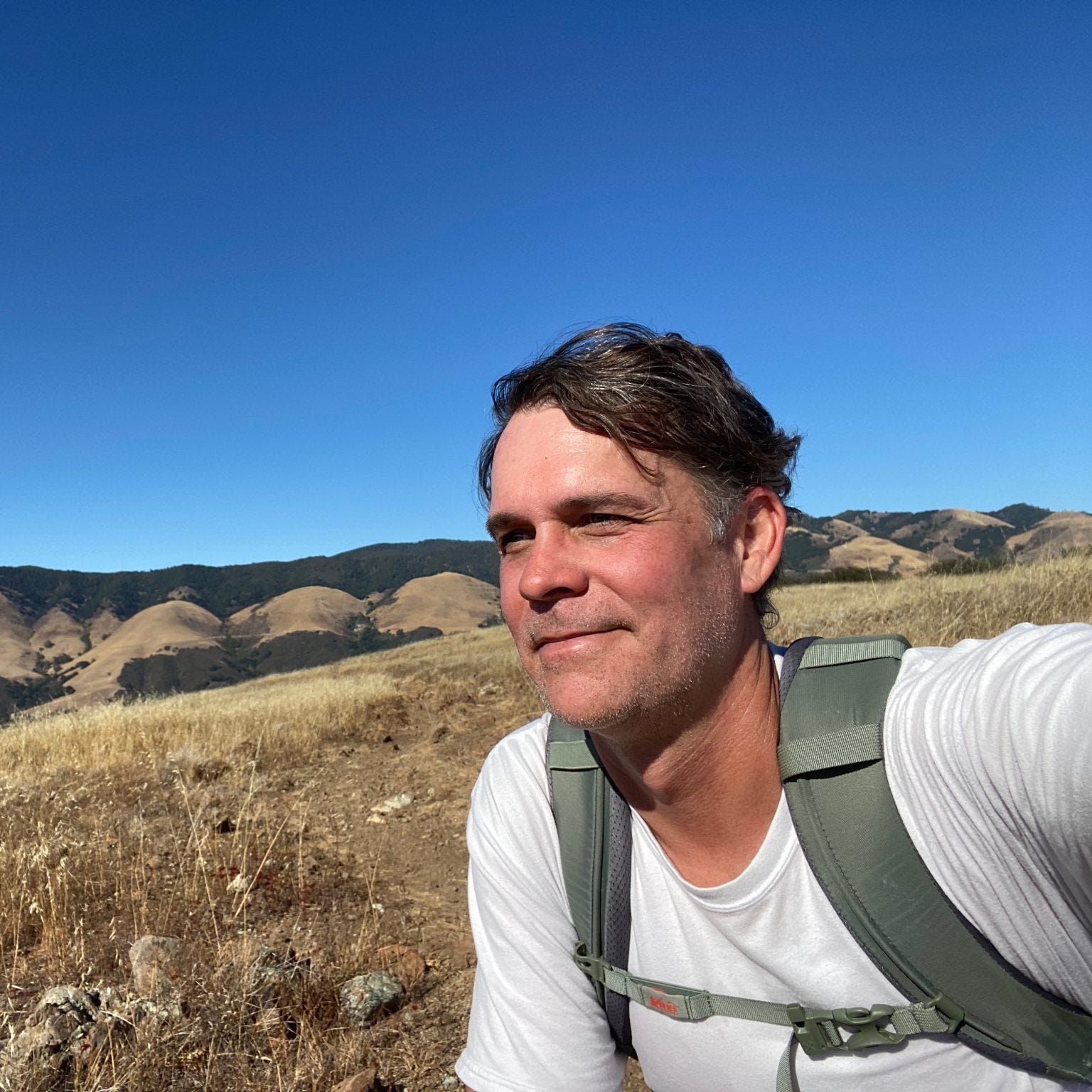
is Executive Editor at the Humans and Nature Press Gavin develops and directs transdisciplinary projects that seek to illuminate what it means to become human within a more-than-human world. Gavin received a BA from Pepperdine University, a Master of Divinity from Princeton Theological Seminary, and his doctorate from the University of Florida, with a specialization in Religion and Nature. His dissertation research examined the religious, cultural, and ethical values involved in the reintroduction of wolves to the southwestern United States.
Read:
Editor of book series Kinship: Belonging in a World of Relations
The Way of Coyote: Shared Journeys
Listen: Urban Ecologies - with Gavin Van Horn
Endless thanks to the audio, visual and editing legends of Here We Are:
Matt Woodham Treat Lightly
Music by Michael Garfield ‘Listening to plants


