


All education is environmental education. By what is included or excluded, emphasized or ignored, students learn that they are part of or apart from the natural world.
Orr, D. W. (1990). Environmental education and ecological literacy. Education Digest, 55(9), 49-‐ 53.
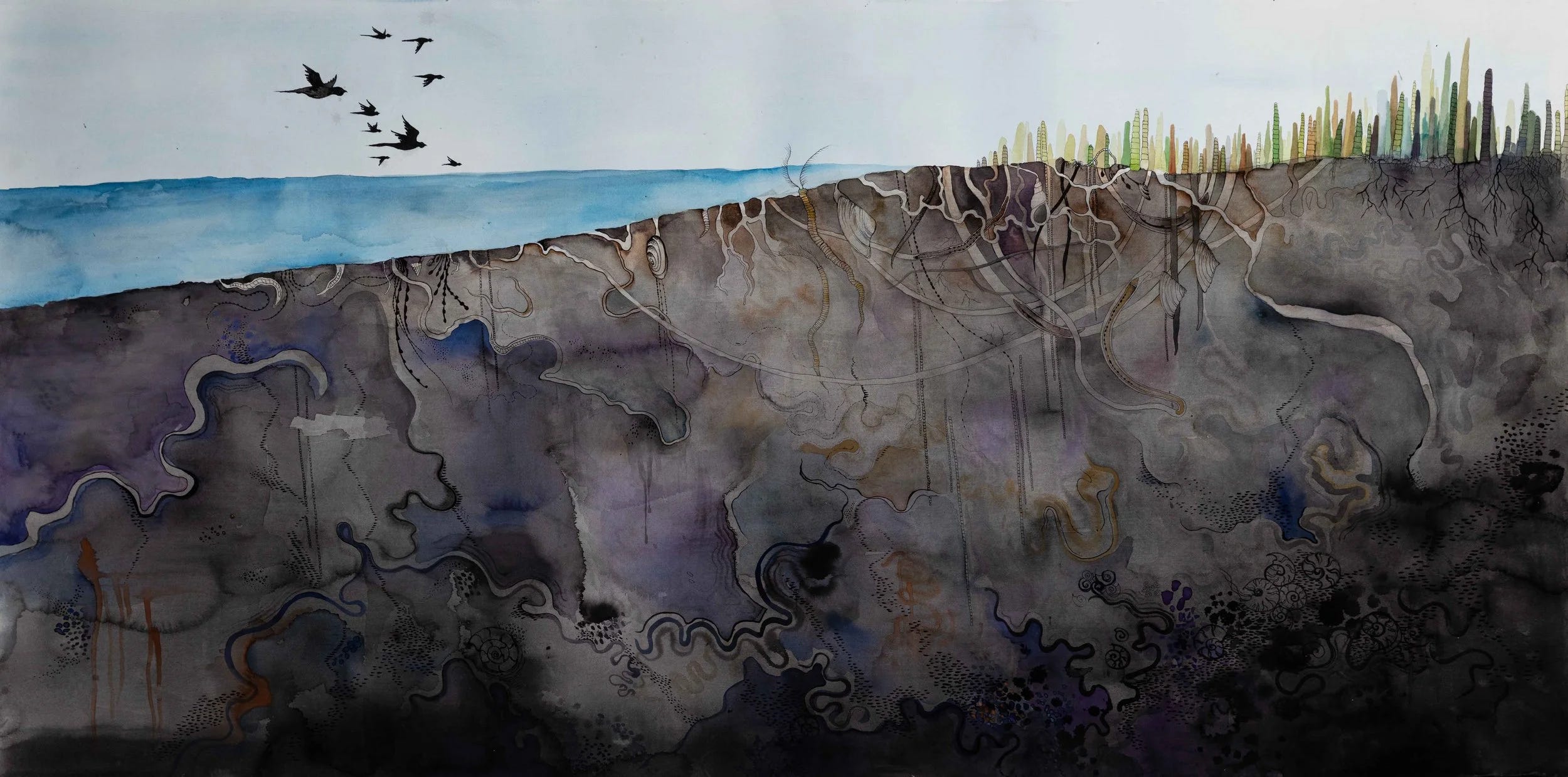
Swampy Saltmarsh by Aviva Reed
The David Orr quote above is taken from his essay ‘What is Education for?’ and as we re-enter the school year this week down here is Tasmania, Australia I feel it is fitting to both visit this line of enquiry as well as offer the words and experiences of the innovative and inspiring educator Dr Cher Hill.
So let’s begin by either gently (or aggressively if that better suits your style) asking ourselves these questions that Cher raises -
”What is education for?
“To know and deeply connect with the land is a sacred right that must be nurtured by all educators”
If our children aren’t experiencing how place connects us all, not only in our current relationships, but in our past and present and future relationships then what is education for?
And if you’re a teacher and you’re not offering your students and yourself the kind of stretchy portals for conversation and growth together and creating opportunities for decolonization and relational land-centered learning then what is teaching for?
I feel it is important to iteratively check your ego and standpoint and enquire into what the needs of the next generation might be whilst acknowledging and critiquing where and why the current education system evolved and what it is perpetuating. Realistically it is beyond the time to reimagine education but no less critical to keep trying.
The Reimagining Education Ecoversities conference is coming up and is ‘a playful invitation to reflect, co-create and connect with other voices who share paths of un/learning, unraveling the limits of mainstream education while encountering cracks overflowing with richness, possibility and astonishing aliveness’. I also recommend just sitting with Reimagining Education tagline which is:
Because how we learn changes how we live
In Cher’s praxis they ‘invite the land and the children to guide the learning’ so how do you think this way of learning may change how we live?
I like to ask myself regularly what is education for? and offer a little exercise called Education Soup below if you would like to give it a go.
Here We Are - Reimagining Education Exercise
Education soup - A nourishing dive into your beliefs and perspectives on - What is education for?
There is no recipe for this soup; simply give yourself a moment to identify the ingredients and processes you currently apply to understanding or engaging with education. There are no right or wrong answers this is just for you to bring some clarity to where you are at in terms of your approach to education and/or educating.
You could take the format of writing a recipe or drawing a pot of soup if it is helpful or just have a think about it next time you’re sipping soup.
If you want to take the next steps you can look at alternative ingredients and processes for creating a rich and nourishing education soup and reimagining education.
Here is the link to youtube clip of Here We Are with Cher Hill
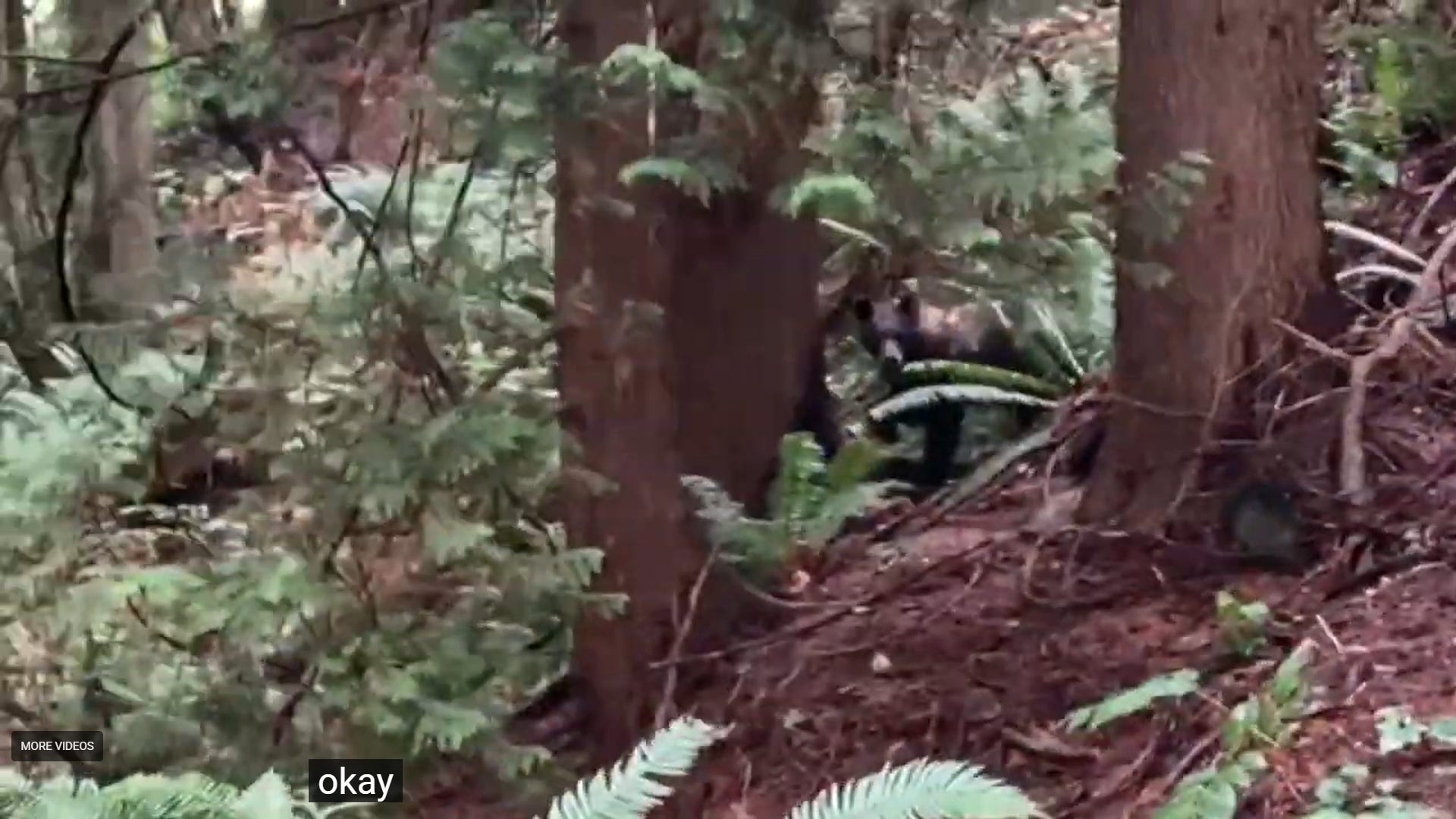
and here is a still from the video of ‘the bear!’
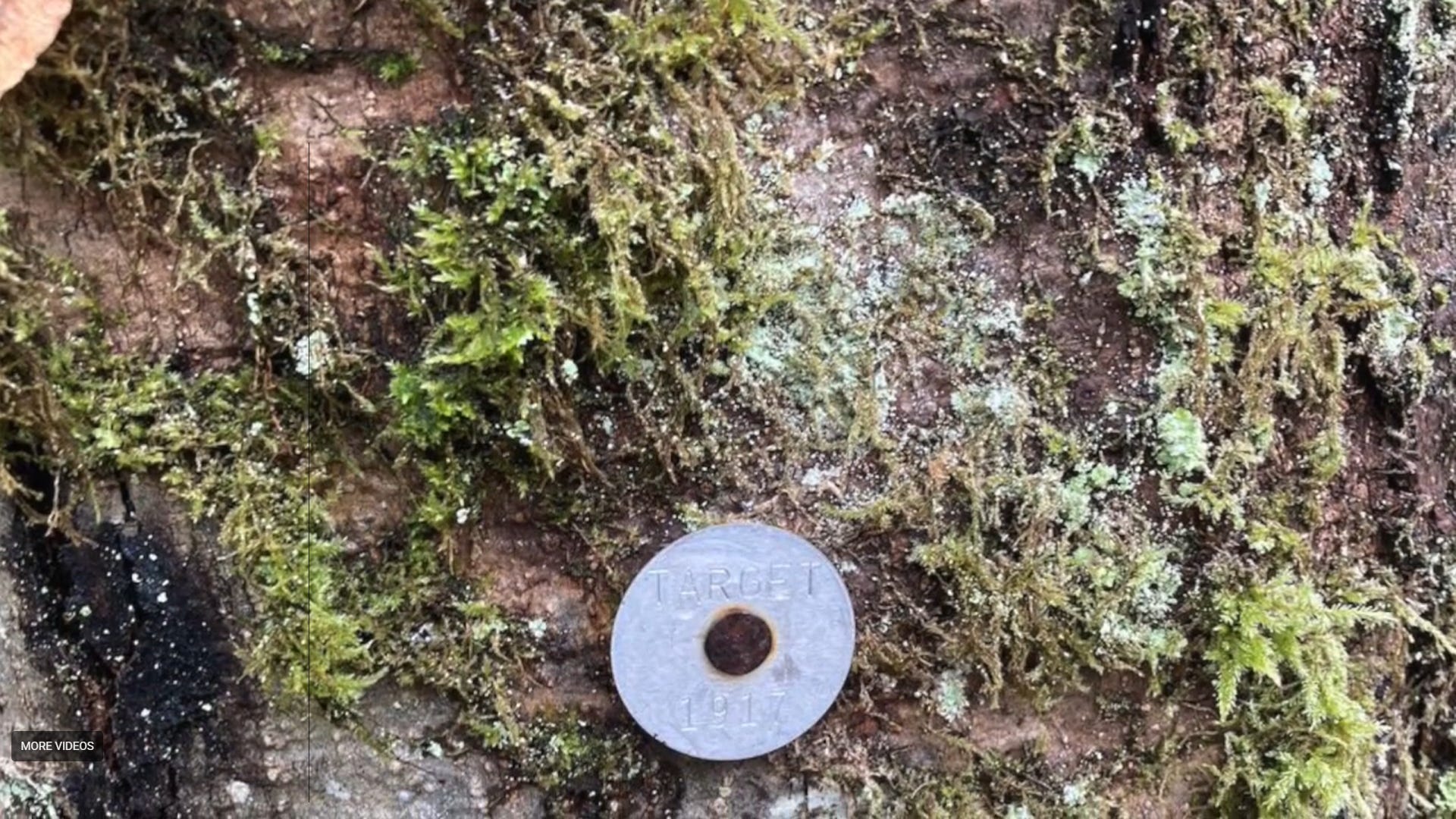
During the recording Cher asks us to pause and contemplate - What do you think this metal object is that was nailed to the tree?
There is much overlap between Cher’s approach and mine to education and I appreciate her ability to wear and roll both her academic and activist sleeves up and get into it.
Unfortunately, I don’t have time to unpack the correlations this week because the 2026 school year has just launched and I’ve only just received my teaching timetable and been thrown the curriculum focus a few days ago so effectively have one week to get everything ready before I have students… and by one week I mean a couple of stolen hours in between parenting and other work ie. I’m writing this whilst my children listen to an audiobook. So what a fantastic opportunity to combine pulling together my term 1 unit and this post at the same time - genius if I may say so myself though it might be a dreamy and convoluted post.
I believe I have made mention previously that strange and delightful synchronicities come about in this work and just to demonstrate this guess what I received as the curriculum focus for this term following on from last week’s geology focused post Here We Are Turning to Stone? Yep you guess it…
Earth and space sciences
compare the observable properties of soils, rocks and minerals and investigate why they are important Earth resources.
Ha! For a hot minute I thought maybe the school leadership team were dedicated followers of Here We Are and been inspired by last week’s post where I shared both the personal and societal value of geologist Marcia Bjornerud’s work promoting and delineating the importance of developing a geological lens. They hadn’t.
But it definitely felt like I threw it out into the world and was hand delivered a gift and invitation back. So I bowed down with deep reverence and accepted the re/quest and now my unit this term is surprise, surprise called Here We Are Turning to Stone. And then surprise, surprise my copy of Turning to Stone arrived in the mail. Things are getting exciting.
The educational, experiential aims and storytelling objectives for this unit will essentially be taken from Marcia with the aim being that our students develop a geocentric worldview in which rocks are raconteurs, companions, mentors, oracles, and sources of existenial reassurance. We will create spaces and opportunities where from an early age children see that they are on an ancient sacred path that stretches across time and that their growing up and growing old are to be celebrated not feared.
So thank you again Marcia I have a clear and poetic vision but now what?
Here is my process so far. Backing it up a bit to the arrival of the curriculum focus.
Utilising the curriculum - When developing a unit I request the year level curriculum focus because integrating it does attest to the utility and merit of the program and justify the investment for school community quantitatively. The tick box system is ticked.
It also demonstrates the versatility of the program and it provides an opportunity to breathe life into the curriculum whilst supporting classroom teachers in delivering the heavy demands of the curriculum and potentially taking a load off them whilst simulataneously laying out fertile foundations for them to continue the exploration. This is not to say that the social emotional wellbeing and environmental benefits of the programs are not paramount and valued but linking to the curriculum does provide extra layers of rigour and value.
The other aspect I enjoy about being guided by a curriculum link is that I love a challenge, I love stretching a boundary and a curriculum link it is like receiving a seed - packed full of unknown, expansive potential. What will grow when I water and tend it. Well that’s what this post is about, creating the garden bed for this ‘seed’. It becomes a catalyst, a limit for guiding a cascading creativity that I thrive on. The program framework is so flexible and all encompassing you can be thrown any topic and when it lands and takes root it can grow into something abundant and interesting with rich learning potential for everyone including me.
So the first step for me is preparing the garden bed for this ‘seed’ - from which the story and the activities for the unit will sprout. This involves a composting together a combination of things like site assessments, research, networking, dreaming and listening.
Here We Are - in the garden. Before any decisions are made a priority consideration is the garden and/or school grounds and identifying tasks and projects that are necessary in order to ensure the garden - our main teacher - is maintained and productive and those of us maintaining it don’t feel overwhelmed by the space and like we will be able to achieve the goals within the program. For example, this term we need to prepare and ensure the planting of late summer/autumnal beds for our annual crops.
Marrying these pragmatic goals with the educational and experiential goals of the unit drives the formulation of the explicit learning, practical and creative small group acitvities. What these look like are also driven by the children.
Here We Are with the children. It was a privelege to be at school and doing our site assessment and initial dreaming/planning with the children having just returned after the summer holiday. They poured out of the classroom at recess and descended on the garden area enthusastically searching for ripe berries, discovering (and unfortunately harvesting) unripe grapes, yearning for the return of the chickens, eager to help remove sweet peas, keen to hear whether their class is scheduled for gardening and joyously in awe of the form and beauty of the flowers. It was a wonderful reminder of both the why as well as the how providing insight into engaging children in tasks of care and companionship with more than human - from chickpeas to chickens.
Here We Are Travel Hopping with Google Map Mind. This is like floating and dancing through clouds I’ll admit where I draw in the layers and scales that will need to woven through the learning and story including the local context and geology, zooming out to Tasmania’s geological stories and relationship to Australia and surrounding continents. Locating these within broader Earth processes across and through time and remembering to connect back to students personal connection with Earth’s processes, and how they correlate to bodily processes like breathing, hydration, metabolism and using these as a map for developing an awareness of the geological processes. I dance around different concepts and relationships exploring ways to see and understand ourselves as expressions of Earth’s processes. I open and sit with questions arising from seeing the earth as a living system.
Here We Are with Country. An important guide for my own learning and understanding that feels powerful, transformative and ‘right’ is the concept of Country. There is much gesturing towards the need for connecting with, caring for and honouring Country and I am aware that I might also be meerly perfomative too so I don’t feel comfortable making any claims about what we understand or are achieving in this area but I do really value the expansiveness of the concept of Country despite not necessarily having the relationships and knowledge to understand this. ‘Country is alive. Country is timeless. And Country is us’. I feel this aligns with becoming Earthlings and very much forms my map for finding meaning, what I feel in the phrase Here We Are.
Country is a word that holds many different meanings for First Nations people, especially given the diversity of First Nations across the continent.
But there are certain concepts and ideas about Country that many First Nations people share. For instance: Country is alive. Country is timeless. And Country is us.
What is Country? Gem Pol
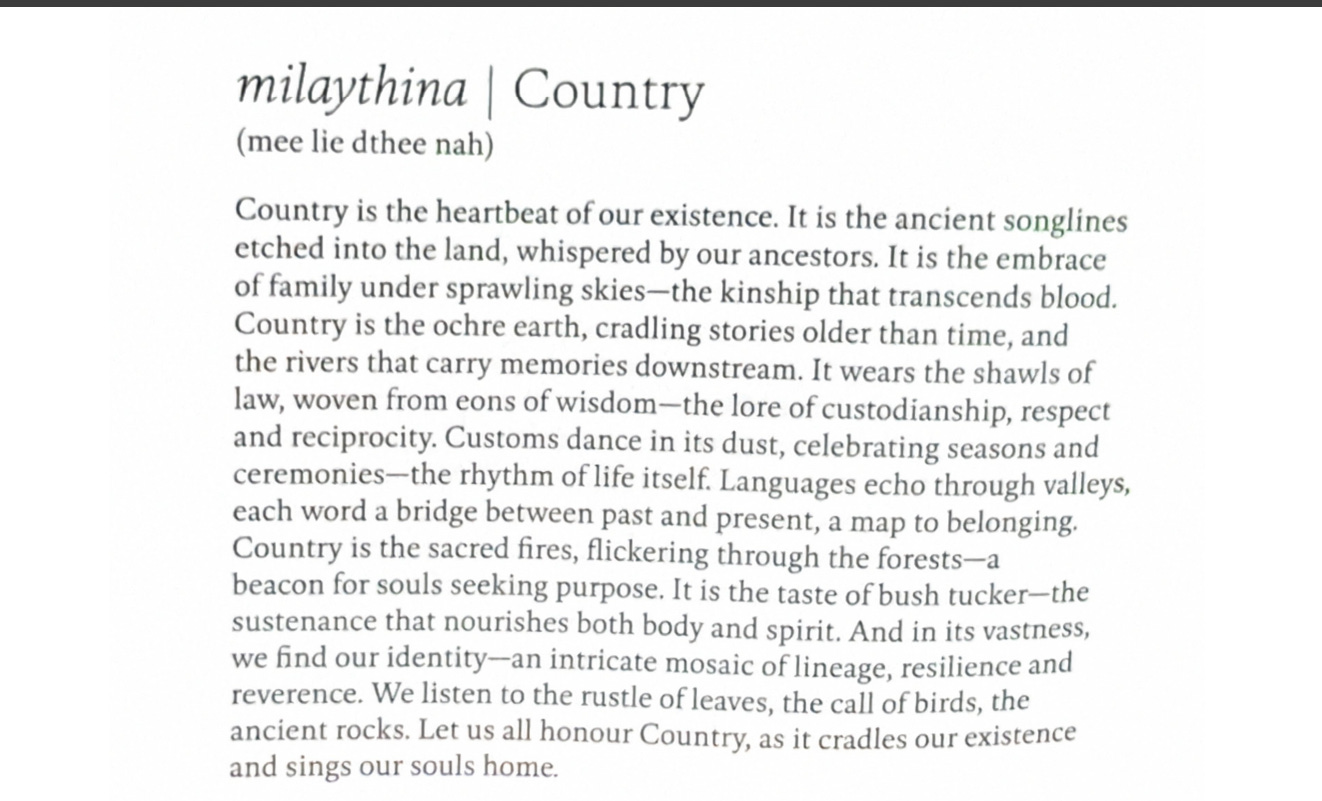
Country as I am understanding it is embodied, relational and dynamic and I hold and draw and have such immense appreciation and gratitude from this description by Trish Hodge in Palawa tunapri - Knowledge of our ancestors. Milaythina/Country is describes relationally and sensorially as the rhythm of life itself, map to belonging, cradles our existance and sings our souls home and provides much guidance in understanding and action.
This will guide the story as it unfolds as well as my efforts to listen to the story that comes out of Country. For me the substrate for the Here We Are program is this stable yet fertile grounds that recognise that the palawa/pakana people of lutruwita/Tasmania are the key “emblem of endurance and adaptability” (Theresa Sainty). I hold and use Craig Everett’s moto ‘Sacred not Secret’ as a guide and we attempt to bring palawa/pakana voices into and echo them through all aspects of our program. ‘Here We Are’ in this respect means I hear our First Nations people say our culture, our language, our worldviews, our children - Here We Are surviving against all odds and still guiding with generosity. We (Foodweb Education) acknowledge and hear your voice, thank and respect you, draw inspiration from and aim to propagate, integrate and grow this understanding through our storytelling, educational framework and praxis.
So now by this stage the fertility is pumping, diversity is cranking and complex interactions start coming together in this garden. I exist in this floating state ironically not very present to the prosaic aspects of life, swimming amidst ideas for the story and stories that will unfold throughout the term. I constantly have to use Here We Are as a practical tool - a full blown winch and anchor to pull me back down to do the dishes and make lunch for my kids. I find this balance very challenging BTW.
I’m gathering resources and relationships I will need to carry me through the term. Books, materials, equipment, ingredients, contacts.
I now need I get to know the puppets and potential characters and investigate how they interact with soil and rocks and what quests and learnings they might encounter and ways they may deliver.
I will sit with the components of soil and look at soil formation and our human impacts on them including our role of nourishing plants through increasing soil fertility and biodiversity.. enhancing life. I’ll zoom in on the living soil, and the elements the ingredients for life made available to us through the living soil and biochemical relationships with plants.
I’ll revisit and dream up activities that will give time and space to the discovery of the stories in the stones rocks and finding ways to implement Marcia’s practices as well as the long and history of human evolution through our intimate relationships with rock including the stone tools, quarry sites and knapping grounds provide valuable insights into the techniques, materials and processes of stone tool making. They evidence a sophisticated body of knowledge and skills developed and adapted over countless generations.
I’ll collect materials for conducting experiments and observing and understanding of soil and rock processes within the context of our connection to these. For example, we will contextualizing soil pH tests in the broader understanding of nutrient availabailbity and use for life. Using our own bodies as maps for understanding Earth’s systems biogeochemical processes.
I’ll dive into local geological maps and texts and knowledge keepers.
There’s a lot bubbling up and swimming around that needs to become grounded in tangible organisation of materials and activities as well as an entire story that needs to come to life out of the rocks. I’m excited for where this journey will take us.
So this is where I am at today. Now it is time for me to take all of this garden of potential…The soil and seeds of ideas and practicalities and give it the respectful amount of attention and time to sprout. Over the next few days I will spend time sitting with or walking on Country, holding rocks and breathing (literally doing breath work) to nurture a story into existence. I’m imagining a group of native animal characters connected through mysterious different rocks embedded in their bodies drawn to each other and a particular location that find themselves on quests that simulate the major geological processes that resulted in the formation of Tasmania whilst leading to renewed sense of embodied belonging and awareness of participation and dependence on each other and earth’s proceses. This could be too ambitious or just a crap idea and I’m not sure I have the skills to pull it off anyway but I trust in this orogenic creative process and know that whatever story comes it will be a fun adventure with lots of rock love and laughs. Wish me luck.
Here are some important resources:
The Introduction to Decolonisation 4 week online course will be hosted again from 4-25 March 2026 by Australian Earth Laws Alliance (AELA) and Future Dreaming.
Growing on Country is a course for anyone in any field (from permaculture, regenerative agriculture, syntropics, horticulture, nursery work, landscape design, community gardens to backyard pottering), who wants to be an ally when growing, gardening or engaging with Indigenous plants, people and communities on unceded land. citations to date
Feeling and Hearing Country as Research Method Dr Anne Poelina et al
Guidance on seasonal ways of being from Boonwurrung Seasonal Calendar 2026
A reminder to challenge purely epistemic decolonization. Land back programs and/or dedicating percentage of income earnt on Country to projects that support First Nations communities to care for Country like Pay the rent , FireStick Alliance and other local First Nations initiatives.
Thank you Cher for all of these reminders and inspirations as we enter another exciting year of learning on and with Country.
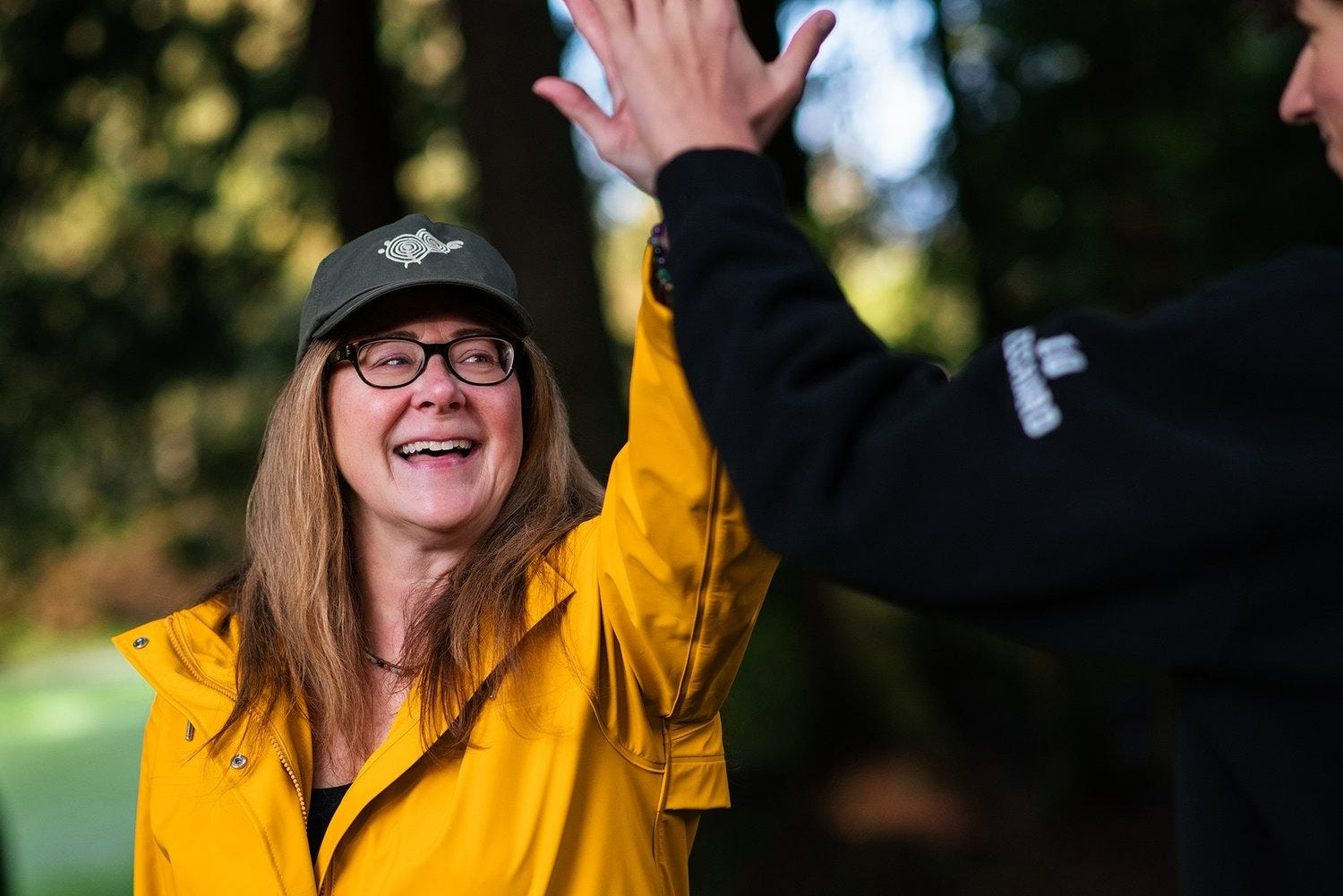
Dr Cher Hill Cher is settler scholar with Finnish, Swedish, Scottish, and English ancestry. She is an Assistant Professor in the Faculty of Education at Simon Fraser University in British Columbia, Canada. She is deeply invested in advancing and studying educative experiences that contribute to more connected, thriving, and just communities (both human and more-than-human).
Cher Hill Website
Endless thanks to the audio, visual and editing legends of Here We Are:
Matt Woodham Treat Lightly
Music by Michael Garfield ‘Listening to plants


